
Communities First, Environment Always
By: C-Help Team
“We reiterate, wala pong may gustong magputol ng puno but this is the reality of the world we live in. Kaya nga na-coin ‘yung term na sustainable development dahil kinikilala po natin na for our economy to grow and improve, kailangan ng development. Wala po tayong magagawa doon.” — Department of Environment and Natural Resources (DENR) Acting Secretary Juan Miguel Cuna reacting to people’s protest against tree cutting along Quirino Avenue in Manila.
While this perspective reflects the common narrative that development is inevitable, it is a wrong interpretation of sustainable development and wala tayong magagawa doon. It also underscores why our theme this June — Communities First, Environment Always — is so urgent. Development is not something communities are powerless against. The Constitution and our laws recognize that people’s rights and ecological balance must guide every decision. True progress is not measured by what we cut down or build over, but by how we protect communities and sustain the environment for generations to come.
Rights Before Roads
Development should never be pursued at the expense of people’s rights and the environment. The principle “Communities First, Environment Always” rests not only on moral grounds but on clear constitutional and legal mandates. Article II, Section 16 of the 1987 Philippine Constitution guarantees the right of the people to a balanced and healthful ecology. Jurisprudence, such as Oposa v. Factoran, affirms that this right extends to future generations. Internationally, the United Nations has recognized the right to a clean, healthy, and sustainable environment as a fundamental human right.
These provisions establish that communities are not passive recipients of development’s consequences, they are rights‑holders whose voices must shape decisions. Protecting livelihoods, health, and ecosystems is not optional, it is a legal obligation.
These constitutional and international guarantees remind us that protecting communities is not simply aspirational, it is a binding duty. But to understand why Communities First, Environment Always must guide every decision, we need to look closely at what this principle means in practice. At its core, it affirms that communities are the foundation of sustainable progress, and that their rights, welfare, and voices must shape the path of development.
Communities at the Core
At the heart of this month’s theme is the recognition that people are not just beneficiaries of development, they are its foundation. When decisions respect communities, protect their rights, and uphold their welfare, progress becomes both sustainable and just. This principle unfolds across several dimensions:
- Human Rights Dimension
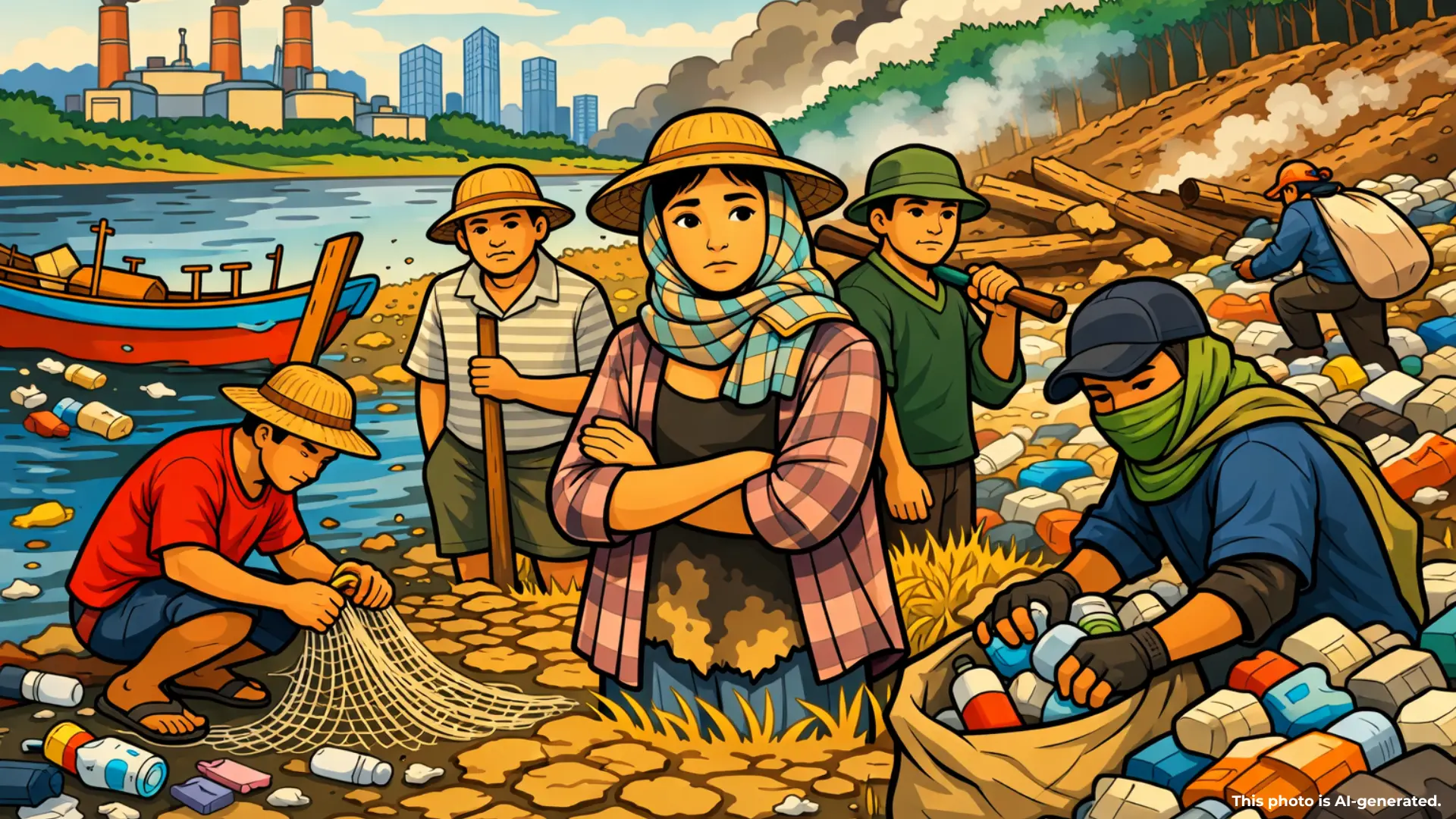
Communities—fisherfolk, farmers, waste workers, indigenous peoples—are the first to feel the impacts of environmental degradation. Their rights to livelihood, health, and participation are inseparable from environmental protection.When fishing grounds are reclaimed, when farmlands are subjected to unsafe technologies, or when waste workers lose access to recyclables, it is not simply an economic setback, it is a violation of fundamental human rights. These actions strip communities of their right to livelihood by depriving them of the resources they depend on, compromise their right to health through exposure to pollution and unsafe practices, and erode their right to participation by excluding them from decisions that shape their future. Environmental degradation, in this sense, is not just ecological harm, it is the denial of dignity, agency, and justice for the very people who bear its consequences.
- Food Security & Public Welfare
Healthy ecosystems sustain food production and public health. When communities are sidelined, the ripple effects reach dining tables, hospitals, and households nationwide. But when communities are sidelined in development decisions, the ripple effects extend far beyond their immediate livelihoods, they reach dining tables, hospitals, and households across the country.Reclamation that reduces fish catch, agricultural practices that erode biodiversity, or waste policies that compromise air and water quality all translate into diminished food supply and heightened health risks. What begins as an environmental burden on fisherfolk, farmers, or waste workers quickly becomes a national concern: rising food prices, reduced access to affordable protein, and increased vulnerability to disease.
- Intergenerational Justice
Decisions made today determine whether future generations inherit a livable environment. The law recognizes this duty of stewardship, most notably in Oposa v. Factoran, which established the principle of intergenerational responsibility: that the right to a balanced and healthful ecology belongs not only to the present but also to generations yet unborn.When forests are cleared, seas polluted, or ecosystems destroyed, the damage is not confined to the communities of today, it robs children and grandchildren of their rightful inheritance. This is why intergenerational justice is not simply a moral appeal but a constitutional and legal obligation.
- Legal Safeguards
Statutes like the Clean Air Act (RA 8749) and the Ecological Solid Waste Management Act (RA 9003) embody the principle that development must prioritize people’s welfare and ecological balance. These laws are not mere policy preferences; they are binding safeguards designed to protect communities from toxic air, unsafe waste practices, and unsustainable development.The Clean Air Act prohibits harmful emissions and incineration that endanger public health, affirming that clean air is a right, not a privilege. The Solid Waste Management Act, meanwhile, mandates waste reduction, recycling, and resource recovery, ensuring that communities benefit from safer, healthier environments rather than bearing the costs of pollution. Together with fisheries laws, biodiversity statutes, and international commitments, these legal frameworks establish clear boundaries: progress cannot be achieved by sacrificing people’s health, livelihoods, or ecosystems.
Lessons from the Frontlines
These principles are not abstract ideals, they are tested daily in the realities faced by communities across the country. When policies ignore these dimensions, the consequences become visible in lost livelihoods, degraded ecosystems, and deepening inequality. The experiences of fisherfolk, farmers, and waste workers reveal what happens when development forgets its human and ecological foundations.
Projects such as Manila Bay reclamation, GMO commercialization, installation of waste‑to‑energy facilities, and tree‑cutting for infrastructure illustrate what happens when communities are excluded. Fisherfolk lose access to fishing grounds, farmers face seed dependency, waste workers lose income, and residents suffer floods and pollution. These examples remind us that sidelining communities leads to ecological harm and social injustice, but they are not the core of the story. The core is the principle: development must be people‑centered and ecologically sound.
These examples are not just case studies of ecological harm, they are lived realities that confirm the dimensions earlier discussed. Yet the lesson is larger than the projects themselves.
These lived realities show how easily rights, food security, and future generations are compromised when communities are sidelined. But they also point us toward what must change: a development path that honors participation, enforces safeguards, and restores justice. From these lessons, the way forward becomes clear.
DENR’s Mandate to Protect the Environment
The DENR bears the crucial responsibility of protecting the nation’s natural resources and promoting sustainable practices under its organic law. This mandate requires DENR to act decisively in defense of the environment, rather than proclaiming walang magagawa. Such a line undermines the agency’s purpose and erodes public trust in its capacity to safeguard the environment for present and future generations.
In the case of tree cutting along Quirino Avenue in Manila, DENR’s mandate obliges it to thoroughly evaluate, regulate, and prevent actions that diminish urban greenery and ecological balance.
In sum, the permitting of widespread tree removal, reclamation of Manila Bay, commercialization of GMOs in agriculture, and waste-to-energy contradicts the agency’s commitment to conservation and responsible resource management. DENR is meant to be a steward and advocate, ensuring that development never comes at the irreversible expense of the environment. Meron itong magagawa, if it chooses to do so.
Growth Uplifts People, Protects Ecosystems
True progress is measured not only by economic growth but by whether communities thrive and ecosystems endure. To put communities first, environment always means:
- Ensuring public participation in environmental decision‑making.
- Enforcing constitutional and statutory rights to healthful ecology.
- Pursuing inclusive development that empowers communities rather than displaces them.
- Recognizing that environmental protection is justice for present and future generations alike.
To the DENR and the entire government, put communities first, environment always. True progress is achieved when growth uplifts people, protects ecosystems, and secures a livable future for generations to come.